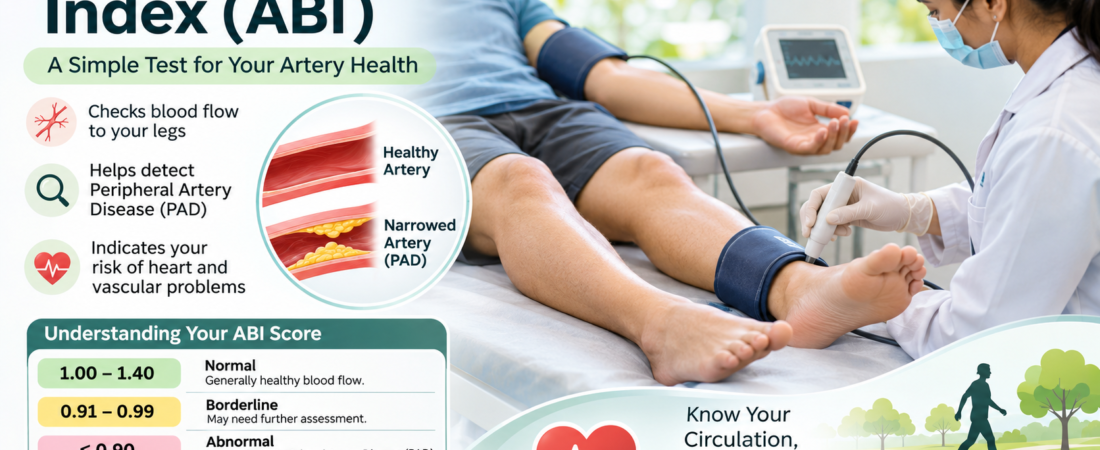
Ankle-Brachial Index (ABI): A Simple Test That Can Reveal Your Artery Health
Health & Wellness · 7 min read
Introduction
Your legs do more than help you walk, run and stay active. They can also provide important clues about the health of your heart and blood vessels.
One simple, non-invasive test that helps assess blood circulation in the legs is called the Ankle-Brachial Index (ABI).
The ABI test compares blood pressure measured at your ankles with blood pressure measured at your arms. It helps identify poor blood circulation caused by narrowed or blocked arteries, particularly a condition known as Peripheral Artery Disease (PAD).
Understanding your ABI score can help you recognise potential circulation problems early and take steps towards better vascular health.
What Is the Ankle-Brachial Index (ABI)?
The Ankle-Brachial Index is a medical measurement used to evaluate blood flow to the lower limbs.
It is calculated by dividing the systolic blood pressure at the ankle by the systolic blood pressure in the arm.
In simple terms:
- Ankle pressure: Measures blood pressure in arteries around your ankle.
- Arm pressure: Measures blood pressure in your upper arm.
- ABI score: Compares these two measurements to assess circulation.
A healthy ABI generally indicates that blood is flowing adequately through the arteries supplying your legs.
Why Is the ABI Test Important?
The ABI test is particularly useful for detecting Peripheral Artery Disease (PAD), a condition in which arteries supplying blood to the legs become narrowed or blocked.
This usually happens due to atherosclerosis, where fatty deposits (plaques) accumulate inside artery walls.
The test can help:
- Detect reduced blood circulation in the legs.
- Identify possible Peripheral Artery Disease.
- Evaluate people experiencing leg pain while walking.
- Assess circulation in people with certain cardiovascular risk factors.
- Help doctors decide whether further vascular investigations are needed.
PAD is important to identify because it is associated with an increased risk of heart attack, stroke and serious complications affecting the legs. JACC+1
Who Should Consider an ABI Test?
An ABI test may be recommended for people who have symptoms or risk factors associated with poor circulation.
You may need an evaluation if you experience:
- Leg pain or cramping while walking that improves with rest.
- Unusual tiredness or weakness in the legs.
- Coldness in one foot or leg compared with the other.
- Slow-healing wounds on the feet or legs.
- Changes in the colour of your feet.
- Reduced or absent pulses in the feet.
People with certain risk factors may also benefit from assessment, including:
- Diabetes.
- High blood pressure.
- High cholesterol.
- Smoking history.
- Chronic kidney disease.
- Known cardiovascular disease.
An ABI test is not recommended as routine screening for everyone without symptoms or increased risk. A healthcare professional can determine whether it is appropriate. JACC+1
How Is the Ankle-Brachial Index Test Performed?
24.2 Peripheral Vascular System – Clinical Nursing Skills | OpenStax
Periphere arterielle Verschlusskrankheit (PAVK) – Angiologie
Ankle-Brachial Index: Test & What It Means
7
The ABI test is simple, painless and non-invasive. It generally takes around 10–15 minutes, although the exact duration varies.
Here is what happens during the procedure:
Step 1: Rest before the test
You lie comfortably on an examination table for a few minutes to allow your blood pressure to stabilise.
Step 2: Blood pressure measurement in the arms
A healthcare professional measures systolic blood pressure in both arms using a blood pressure cuff.
Step 3: Blood pressure measurement at the ankles
Blood pressure cuffs are placed around both ankles. A handheld Doppler ultrasound device helps detect blood flow in the arteries of the feet.
Step 4: ABI calculation
The healthcare professional uses the measurements to calculate a separate ABI value for each leg.
The test does not require surgery, injections or radiation exposure. JACC+1
How Is the ABI Score Calculated?
The ABI is calculated using the following formula:
\[ ABI = \frac{\text{Higher ankle systolic pressure}}{\text{Higher arm systolic pressure}} \]
For each leg, the higher of the two ankle artery pressures is divided by the higher of the two arm pressures.
Example:
Suppose the measurements are:
| Measurement | Blood pressure |
|---|---|
| Right arm | 130 mmHg |
| Left arm | 125 mmHg |
| Right ankle | 150 mmHg |
| Left ankle | 120 mmHg |
Right ABI:
\[ 150 \div 130 = 1.15 \]
Left ABI:
\[ 120 \div 130 = 0.92 \]
In this example, the right leg has a normal ABI, while the left leg has a borderline ABI.
Understanding Your ABI Results
The ABI score helps doctors assess whether blood is flowing adequately through the arteries in your legs.
The commonly used interpretation ranges in the 2024 American Heart Association and American College of Cardiology guidelines are:
ABI reference ranges
Normal
Healthy range
1.00–1.40
Generally indicates adequate blood circulation.
Borderline
Needs assessment
0.91–0.99
May require additional evaluation depending on symptoms.
Abnormal
Possible PAD
≤0.90
Suggests reduced blood flow and may indicate Peripheral Artery Disease.
Non-compressible
Further testing
>1.40
May indicate stiff or calcified arteries. Further testing is often needed.
Reference: 2024 ACC/AHA Peripheral Artery Disease Guidelines. JACC+1
Important: An ABI value below 0.40 can indicate severe circulation impairment. Such a result needs prompt medical assessment, particularly if accompanied by pain at rest, wounds or tissue damage.
What Does a High ABI Score Mean?
A high ABI score does not necessarily mean excellent circulation.
Sometimes, arteries become stiff due to calcification, making them difficult to compress with a blood pressure cuff.
This is more common in people with:
- Diabetes.
- Chronic kidney disease.
- Advanced age.
As a result, the measured ankle pressure may be artificially high, even when blood circulation is impaired.
Doctors may recommend a Toe-Brachial Index (TBI), Doppler waveform assessment or other vascular investigations to obtain a clearer picture of circulation. OUP Academic+1
How Can You Maintain Healthy Arteries and Improve Blood Circulation?
Why is walking getting harder as I get older?
Maintaining healthy arteries requires consistent lifestyle habits. Although lifestyle changes cannot reverse every case of arterial disease, they can help reduce cardiovascular risk and support vascular health.
1. Walk Regularly
Walking is beneficial for cardiovascular health. For people diagnosed with PAD, structured walking exercise is an important part of treatment.
Start at a comfortable pace and gradually increase activity. People with diagnosed PAD should discuss an appropriate exercise programme with their healthcare professional.
2. Eat a Heart-Healthy Diet
Choose foods that support healthy cholesterol and blood pressure levels.
Include:
- Fresh vegetables and fruits.
- Whole grains.
- Beans, lentils and legumes.
- Nuts and seeds.
- Healthy sources of unsaturated fats.
Limit excessive salt, added sugar, deep-fried foods and highly processed foods.
3. Manage Blood Sugar
High blood sugar over time can damage blood vessels and increase the risk of vascular complications.
People with diabetes should monitor their blood glucose and follow their prescribed treatment plan.
4. Control Blood Pressure and Cholesterol
High blood pressure and unhealthy cholesterol levels can contribute to atherosclerosis.
Regular health check-ups can help identify these risk factors early.
5. Avoid Smoking
Smoking damages blood vessels and significantly increases the risk of PAD.
Quitting smoking is one of the most important steps towards protecting your arteries.
6. Maintain a Healthy Weight
A healthy body weight, combined with regular physical activity and balanced nutrition, supports overall cardiovascular health.American Heart Association+1
Can the ABI Test Detect Heart Disease?
The ABI test primarily evaluates blood circulation in the legs. It is not a direct test for coronary artery disease or blocked heart arteries.
However, PAD and coronary artery disease share several risk factors and underlying disease processes.
Therefore, an abnormal ABI result can alert healthcare professionals to a higher risk of cardiovascular complications, including heart attack and stroke.
It may prompt further evaluation of overall cardiovascular health. American Heart Association+1
When Should You Consult a Doctor?
Do not ignore persistent leg pain, cold feet, changes in skin colour or wounds that do not heal.
Seek prompt medical attention if you notice these symptoms.
Seek emergency medical care if you suddenly develop severe leg pain, a cold or pale foot, numbness, weakness or loss of movement. These may be signs of acute limb ischaemia, a medical emergency.
Frequently Asked Questions (FAQs)
1. Is the ABI test painful?
No. It is a non-invasive procedure involving blood pressure cuffs and a Doppler device. You may experience temporary pressure from the cuffs.
2. How long does an ABI test take?
It usually takes approximately 10–15 minutes, depending on the testing procedure.
3. Is an ABI score of 1.0 normal?
Yes. An ABI of 1.0 falls within the normal reference range.
4. Can I perform an ABI test at home?
A reliable ABI measurement requires appropriate equipment, including a Doppler device, and correct measurement technique. A standard home blood pressure monitor alone is not sufficient for an accurate clinical ABI assessment.
5. Does a normal ABI rule out all circulation problems?
No. Some people may have PAD despite a normal resting ABI, particularly when symptoms occur only during exercise. Doctors may recommend exercise ABI testing or other investigations.
6. Is the ABI test useful for people with diabetes?
Yes, but interpretation requires additional care because arterial calcification can produce falsely elevated ABI readings. A doctor may recommend a Toe-Brachial Index or other vascular tests.JACC+2
Conclusion
The Ankle-Brachial Index is a simple yet valuable tool for assessing blood circulation in the legs. By comparing blood pressure in the ankles and arms, it can help identify possible Peripheral Artery Disease and highlight the need for further cardiovascular evaluation.
Understanding your ABI results, recognising early warning signs and maintaining healthy lifestyle habits can help protect your blood vessels and support long-term well-being.
Remember, healthy circulation is an important part of a healthy life.
MEDICAL DISCLAIMER
This article is intended for educational purposes only and should not replace professional medical advice, diagnosis or treatment. ABI results should always be interpreted by a qualified healthcare professional in the context of symptoms, medical history and other investigations.
References